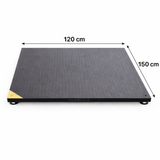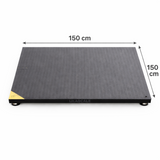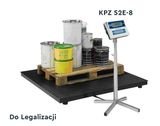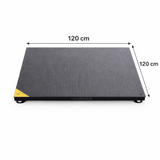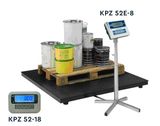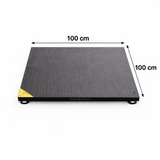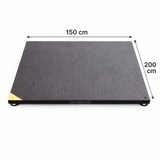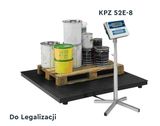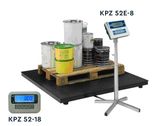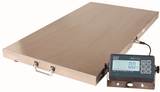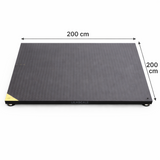

Platform scales available on the market come in a variety of designs and sizes, with different technical specifications that determine how well a particular device will perform in your company or organization.
Platform scales differ from other types of scales in that they allow you to weigh even large items directly on the platform — which makes them especially useful in warehouses. In production halls and distribution centers, platform scales serve as an excellent alternative to pallet weighing systems.
When deciding to purchase a platform scale, it’s important to consider several factors that will help you choose a device that meets your expectations. Which ones exactly? Let’s explore them in detail below.
Platform scales: main functions
Before purchasing a weighing device, let’s clarify what platform scales are used for. They are applied across multiple industries, including:
-
Industry – for weighing raw materials, finished goods, components, building materials, and chemicals.
-
Logistics and transport – for quick and accurate weighing of goods before shipment, ensuring compliance with legal weight limits and transport regulations.
-
Agriculture – for weighing harvests, feed, agricultural products, and livestock.
-
Trade – in wholesale, warehouses, and retail for weighing goods sold by weight.
-
Medicine and pharmaceuticals – for weighing large, heavy objects such as medical equipment or bulk pharmaceutical packaging.
-
Recycling and waste management – for measuring the mass of materials destined for recycling or disposal.
Clearly defining what purpose platform scales will serve in your organization is the first step toward choosing the right device.
Material and size of platform scales
Start by determining where the scales will be used.
-
For indoor areas with dry conditions, powder-coated steel models are suitable.
-
For outdoor environments or industries such as food processing or chemicals, stainless-steel models are a better choice — they are resistant to moisture and chemical exposure.
Space availability also matters. There are different types of platform scales, and at Vagar.pl, you’ll find practical models designed for floor installation.
Regardless of the model, make sure your scale is properly protected against damage from heavy equipment or impacts.
Key features and how they affect your choice
The principle of operation for electronic platform scales is quite simple: the platform rests on strain gauge sensors (load cells) that convert pressure into electrical signals proportional to the weight. The signal is then processed and shown on a digital display.
Although mechanical models still exist, if you want precise measurements and ease of use, electronic scales are the better option.
Here are the key performance features to consider:
-
Capacity and precision – higher capacity usually means lower precision. For weighing objects of varying mass, consider a dual-range scale, which automatically adjusts accuracy based on the load.
-
Platform size – larger platforms cost more, but may be necessary for bulky goods. Think about your current and future weighing needs.
-
Power supply – mains-powered or battery-operated.
-
Tare function – essential when weighing goods with packaging (e.g., cartons or pallets). Most modern scales offer full-range taring, up to 100% of total capacity.
If, for example, a 300 kg scale is used with a container weighing 100 kg, after taring you’ll only have 200 kg available for the actual product weight — so it’s important to account for packaging weight when choosing capacity.
You should also decide whether you need a verified (legal-for-trade) scale — one that has passed inspection and been approved by a certified body. Such scales are required in trade and customs operations, and they must undergo periodic reverification.
For industrial or internal use, verification is not required, but recalibration every 2 years is recommended.
Modern platform scales are user-friendly, and you can easily learn how to operate them from the manufacturer’s manual. No special staff training is needed.
Questions to consider before purchasing
If you’re wondering which platform scale to choose, answer the following questions:
-
Where will the scale be used?
-
What is the maximum load you’ll be weighing?
-
What measurement accuracy do you require?
-
Who will operate the scale, and how often?
-
Do you need a verified or non-verified (technical) scale?
Having these answers will help you quickly find the right platform scale on the Vagar.pl online store.