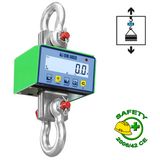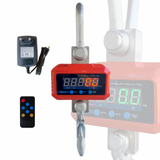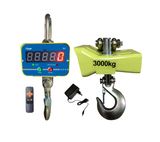

For convenient and efficient weighing of heavy loads such as construction materials, equipment, and containers, crane scales are used. This type of equipment allows weighing suspended loads in a static position. A wide range of professional models is available on the market. Let’s take a look at how to choose a crane scale, taking into account the key parameters of such devices.
🏗️ What is their design? Where are crane scales used?
Crane scales – what are they?
A distinctive feature of such devices is their compact size, which allows them to be used almost anywhere — even in confined spaces.
The design of this weighing equipment is quite simple: it consists of an electronic display that shows the measured weight and a heavy-duty metal hook for suspending loads.
Some models are equipped with remote control functionality, making operation much easier — especially when handling large volumes of materials.
The device is powered by a built-in rechargeable battery.
Crane scales are widely used in warehouses, metal storage facilities, factories, railway stations, seaports, logistics centers, and construction sites.
This type of equipment is ideal for weighing large loads — typically from 100 kg up to 50 tons.
They can be used both indoors and outdoors.
⚖️ How to choose a crane scale: key features
When purchasing this type of weighing device, many buyers focus primarily on the price.
However, high-quality, durable, and highly accurate crane scales cannot be very cheap.
Reliable equipment consists of a robust housing, precision load cells, and a long-lasting battery.
Crane scales from reputable manufacturers are usually certified.
Possessing all the necessary certificates is a key indicator of a reliable, professional-grade weighing instrument.
When deciding which crane scale is best, consider the following important parameters 👇
🔹 Operating conditions
If the scale will be used outdoors — for example, on a construction site — pay attention to the degree of protection against moisture and dust.
The optimal choice is a model with a high IP rating.
For indoor use, a lower protection level (such as IP53 or IP54) is sufficient.
🔹 Housing material
This determines the overall durability of the scale.
One of the best materials is stainless steel, known for its impact resistance.
However, in practice, most crane scales feature aluminum or structural steel housings.
🔹 Metrological characteristics
Two of the main technical features are weighing capacity and resolution (graduation).
Crane scales generally handle loads from 120 kg to 50,000 kg, depending on the model.
For standard production or logistics use, scales rated for 120–2,000 kg are sufficient,
while for heavy-duty industrial applications, models from 3,000 kg up to several dozen tons are recommended.
🔹 Legal verification (metrological certification)
If the scale will be used for commercial purposes, it must be legally verified and certified.
For internal operational use (e.g., warehouse accounting), non-certified models may be used.
🔹 Remote control functionality
This option is useful when the operator must work at a distance from the crane or scale.
The remote control may include a display showing the measured weight.
Most commonly, these are radio-controlled remotes with a range of 50–several hundred meters.
Infrared remotes are also used but typically offer a range of only up to 10 meters.
🔹 Battery life
This parameter is crucial if the scale will be used for long and regular shifts, such as on construction sites.
A battery level indicator is a useful feature that allows you to monitor the device’s performance.
Ideally, the scale should operate for at least one full working shift (8 hours) without recharging.
✅ Conclusion
Now you know what crane scales are and how they work.
At Vagar.pl, you can choose reliable, precise, and certified crane scales that meet all essential requirements.
The catalog includes professional crane scales from trusted and proven brands —
ideal for industrial, warehouse, and construction applications.